If you’re considering JULÄINE™, one of the first things you’ll probably want to know is when you’ll actually see a difference.
JULÄINE™ is made from poly-L-lactic acid, usually shortened to PLLA. PLLA is a biodegradable material that encourages your skin to produce more collagen over time.
Because of that, JULÄINE™ develops differently from a conventional dermal filler. You may see some temporary fullness straight after treatment, but the result we’re actually interested in appears gradually as your own collagen response builds.
This guide explains what those first 12 weeks can look like, what’s happening at each stage, and when it becomes useful to start judging your result.
JULÄINE™ Is Usually Planned as a Course
JULÄINE™ is supplied as a powder containing tiny PLLA particles called microspheres.
Microspheres are simply very small, rounded particles. Before treatment, the powder is reconstituted, which means it’s mixed with a sterile liquid so it can be injected evenly.
That matters because some of the fullness you may see immediately after treatment comes from the liquid used during the procedure and from normal swelling around the injection sites.
That early fullness settles. The collagen response takes longer.
The manufacturer’s product information allows treatment to be reassessed after 2 to 4 weeks, with up to three sessions where appropriate. In the published JULÄINE™ clinical study, patients were treated at baseline, week 4 and week 8.
Your own treatment plan may be different. We’ll decide how many sessions make sense based on your starting point, how you respond and the current UK product guidance.
Treatment Day
What might you notice straight away?
Immediately after treatment, the area may look slightly fuller than before.
You may also notice:
- redness;
- swelling;
- tenderness;
- bruising;
- small changes around the injection points.
These are recognised reactions after injectable treatment.
The most important thing to remember on day one is that the way the area looks straight after treatment isn’t the final JULÄINE™ result. The collagen response we’re trying to create takes time to develop.
Your practitioner will explain your aftercare before you leave the clinic.
What should you do after treatment?
Follow the aftercare instructions we give you at Face Perfect.
There’s inconsistent information online about JULÄINE™ aftercare, particularly around massage, and Nordberg provides country-specific product instructions. We’ll therefore advise you according to the current UK guidance and the way your treatment has been carried out.
If anything is unclear afterwards, contact us rather than trying to adapt instructions you’ve found elsewhere.
The First 24 to 72 Hours
During the first few days, some swelling, redness, tenderness or bruising may still be visible.
For most people, these early treatment effects should start to settle progressively, although everyone responds differently.
The published JULÄINE™ clinical study reported mainly mild and temporary treatment-related reactions. Mild local inflammation was the most common early finding. In this context, inflammation simply means the body’s local response to treatment, which can include temporary redness, warmth, swelling or tenderness.
At this stage, we’re really looking at recovery from the injections, rather than trying to judge whether the treatment has worked.
What’s normal, and when should you contact us?
Some swelling, redness, tenderness and bruising can happen after injectable treatment.
But if something feels significantly different from what we’ve explained to you, contact the clinic.
We’d want to hear from you promptly if you develop:
- severe or worsening pain;
- marked or rapidly increasing swelling;
- unusual changes in skin colour;
- blistering or skin breakdown;
- signs that may suggest infection;
- a persistent or concerning lump;
- anything else that feels worrying or unexpected.
Serious complications are uncommon, but they need prompt assessment when they occur.
We’ll go through the relevant risks with you before treatment as part of your consultation and consent.
Week 1: The Initial Fullness Settles
By the end of the first week, much of the immediate swelling may have reduced.
This is also the stage where some patients feel as though the treatment has “disappeared”.
What they’re usually noticing is that the temporary fullness from the injected liquid and swelling has settled, while the slower collagen response is still developing underneath.
In the published JULÄINE™ study, patients were reviewed at one week mainly to check safety and recovery.
So if you’re looking closely in the mirror at day seven trying to decide whether the treatment has worked, it’s still too early to make that judgement.
Weeks 2 to 4: The Collagen Response Is Developing
Over the next few weeks, your skin’s collagen response continues to develop.
Some people may start to notice subtle changes during this period, while others won’t see much yet. There isn’t a specific day when the collagen response suddenly becomes visible.
This is also around the point when your practitioner may reassess you and decide whether another treatment session is appropriate.
The manufacturer’s information allows reassessment after 2 to 4 weeks, while the main clinical study used four-week intervals.
We’ll base that decision on how you’re progressing rather than simply moving through a fixed number of sessions.
Around Week 4: What Did the Clinical Study Show?
The first published JULÄINE™ study followed 36 patients who were being treated for nasolabial folds, the lines that run from the sides of the nose towards the corners of the mouth.
One month after their first treatment, 44.4% had improved by at least one point on the Wrinkle Severity Rating Scale compared with baseline.
The Wrinkle Severity Rating Scale is a standard clinical scoring system used to grade how noticeable or deep a fold is.
That tells us measurable change can begin relatively early, but the number needs some context.
The study involved 36 patients, wasn’t randomised and didn’t include an untreated control group. In simple terms, everyone knew they were receiving treatment, and there wasn’t a separate group receiving no treatment for direct comparison.
So week four is a useful early checkpoint, but it’s still too soon to expect every patient to have a clearly developed result.
Weeks 4 to 8: Changes May Become Easier to See
During the second month, the collagen response continues and any improvement may become easier to recognise.
Because this happens gradually, it can actually be difficult to notice when you’re looking at your own face every day.
This is where standardised photographs become useful. That simply means before-and-after photos taken in similar lighting, from the same angle and with a similar expression, so the comparison is fair.
The change may be subtle from day to day, but much easier to see when you compare properly taken photographs several weeks apart.
Read: JULÄINE™ vs Profhilo, polynucleotides and other injectables
Around Week 8: A More Useful Review Point
At two months after the first treatment, the same study found that 63.9% of participants had improved by at least one point in nasolabial-fold severity compared with baseline.
That was higher than the result recorded at one month, which suggests that improvement continued to develop over time.
We wouldn’t present 63.9% as an expected success rate for everybody having JULÄINE™. It comes from a small uncontrolled study, but it does give us useful information about how the response developed during those first two months.
Could week 8 include another treatment?
It could.
The main clinical study used treatment sessions at baseline, week 4 and week 8. The manufacturer’s product information allows up to three treatment sessions where appropriate.
Your own course will depend on:
- your starting point;
- the degree of correction needed;
- how you’ve responded so far;
- the current UK product guidance.
If you do have another session, you may experience some of the same temporary swelling, redness, tenderness or bruising again.
Weeks 8 to 12: The Result Continues to Build
By this stage, the collagen response has had more time to affect the appearance and support of the treated area.
But three months doesn’t necessarily mean the process is finished.
A later publication following the JULÄINE™ clinical group reported continued improvement across six months.
That means week 12 is better thought of as a useful review point within a longer collagen-remodelling process.
Collagen remodelling simply means the way your body gradually builds, organises and strengthens new collagen over time.
What might you notice by 12 weeks?
Depending on your treatment course and your individual response, you may notice that the treated nasolabial folds look softer and the surrounding tissue feels better supported.
The aim is improvement that still looks like your face.
Nasolabial folds are a normal part of facial anatomy, so trying to remove them completely can create a result that looks unnatural.
Read about nasolabial folds and nose-to-mouth lines
What If You Haven’t Seen Much Difference Yet?
If the result still feels subtle, it’s worth reviewing it properly before deciding what that means.
We can compare:
- your baseline photographs;
- your current appearance;
- how many sessions you’ve had;
- when those sessions were carried out;
- what degree of change we expected at the start.
A gradual treatment does need time, but we also shouldn’t simply tell every patient to keep waiting indefinitely.
If your response isn’t developing as expected, we’ll review it with you and decide whether the plan needs to change.
Why Before-and-After Photos Matter with JULÄINE™
Gradual changes are difficult to judge from memory because you see your own face every day.
Clinical photographs are much more useful when:
- the lighting is consistent;
- the camera position is consistent;
- your facial expression is similar;
- the timing since treatment is recorded;
- the number of treatments is known.
This is also why any before-and-after photographs we publish should clearly state when they were taken and how many treatment sessions the patient had.
Under UK advertising rules, before-and-after images are treated as evidence of treatment efficacy. In plain English, that means if a clinic uses them to show that a treatment works, the images need to be genuine, fair and not edited in a way that exaggerates the result.
Can You Speed Up the Collagen Response?
There isn’t a proven shortcut that turns a gradual PLLA response into an immediate one.
The best thing you can do is follow the treatment and aftercare plan your practitioner gives you.
Adding extra treatment, shortening the interval between sessions or introducing other procedures simply because you want the result to develop faster isn’t a sensible approach.
If you’re considering another aesthetic treatment while your JULÄINE™ result is developing, speak to us first so we can plan the timing properly.
When Can You Have Other Aesthetic Treatments?
That depends on the treatment.
Dermal filler, Profhilo, polynucleotides, energy-based treatments, chemical peels and other procedures all work differently, so there isn’t one spacing rule that makes sense for every combination.
If we’re building a combined treatment plan, we’ll decide:
- which treatment should come first;
- how much time to leave between them;
- whether we want to see how JULÄINE™ develops before adding anything else;
- what each treatment is actually there to achieve.
Combining treatments can make sense, but each treatment should have a clear purpose.
What Does the Evidence for JULÄINE™ Actually Tell Us?
JULÄINE™ is still relatively new in the UK, having launched here in 2025, so its product-specific evidence base is still developing.
The initial published study followed 36 patients and found progressive improvement in nasolabial-fold severity together with changes consistent with increased type I collagen formation.
Type I collagen is the main form of collagen found in the skin and is an important part of its strength and structure.
A later publication reported continued improvement across six months and included biomechanical assessments alongside clinical measures.
Biomechanical assessments are simply tests used to measure physical properties of the skin, such as firmness or elasticity, rather than relying only on photographs or visual judgement.
The results are encouraging, but the study has limitations.
It was open-label and non-randomised, which means the researchers and participants knew which treatment was being given, and it didn’t include an untreated control group for direct comparison.
So we do have useful clinical evidence showing how patients responded over time, but the evidence base is still smaller than it is for some much older aesthetic treatments.
We think patients should understand both sides of that.
Your First 12 Weeks at a Glance
| Time | What you may experience |
|---|---|
| Treatment day | Temporary fullness, redness, tenderness, swelling or bruising |
| Days 1 to 3 | The immediate injection-related effects should start to settle |
| Week 1 | Recovery continues and it’s still too early to judge the result |
| Weeks 2 to 4 | The collagen response develops and another treatment may be considered |
| Around week 4 | Some patients may begin to show measurable improvement |
| Weeks 4 to 8 | Changes may gradually become easier to see |
| Around week 8 | A more useful point for assessing how the response is developing |
| Weeks 8 to 12 | The result may become increasingly apparent |
| Beyond week 12 | Improvement may continue as collagen remodelling progresses |
Everyone responds differently, so this should be treated as a guide rather than a timetable you need to match exactly.
JULÄINE™ Treatment at Face Perfect Clinic
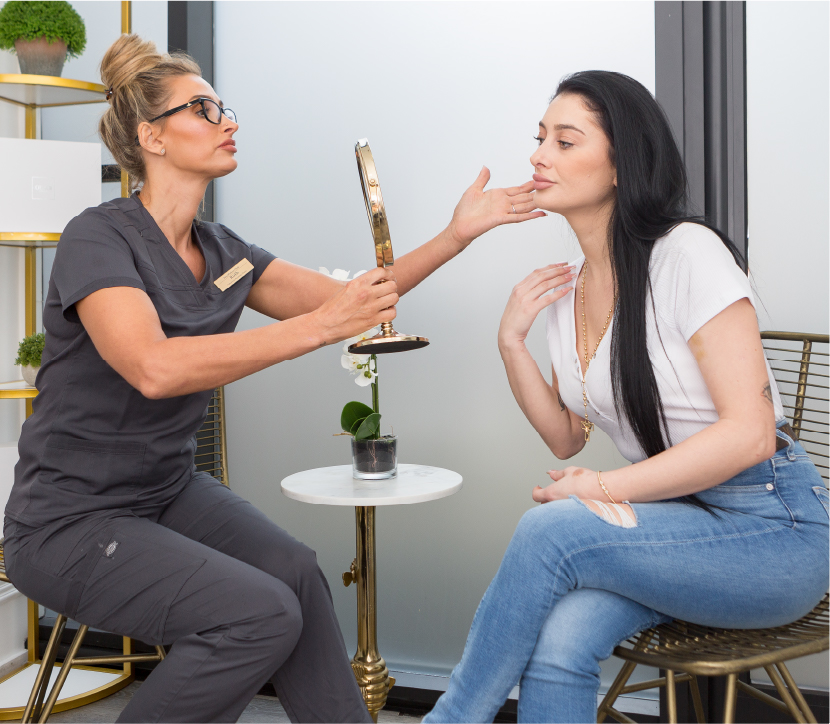
Your JULÄINE™ treatment starts with a consultation at Face Perfect Clinic in Leeds.
We’ll talk about what you’d like to improve, look at your skin and facial structure and decide whether JULÄINE™ is actually appropriate for the concern.
We’ll also explain:
- how many sessions we think you may need;
- what kind of change is realistic;
- the possible side effects and risks;
- your aftercare;
- how we’ll review your progress;
- exactly what the treatment will cost before you decide to go ahead.
JULÄINE™ is currently intended for the correction of shallow to deep nasolabial folds in suitable immunocompetent adults.
Immunocompetent simply means adults whose immune systems are functioning normally.
Learn more about JULÄINE™ at Face Perfect
Considering JULÄINE™?
If you’re looking at the treatment and wondering whether it makes sense for you, come in and talk to us.
You don’t need to decide that you want JULÄINE™ before the appointment. Tell us what you’ve noticed and what you’d like to improve, and we’ll explain which treatment options make sense for your face and skin.
Face Perfect Clinic · Leeds
Frequently Asked Questions
How quickly does JULÄINE™ work?
JULÄINE™ develops gradually because it works by stimulating collagen. In the initial clinical study, measurable changes were seen from one month and increased at two months, while later follow-up showed continued improvement over a longer period.
Will I look different immediately after JULÄINE™?
You may look temporarily fuller because of the liquid used to prepare the product and some local swelling. That should settle while the collagen response develops over the following weeks.
Why can JULÄINE™ look fuller at first and then seem to disappear?
The early fullness comes partly from the liquid used to reconstitute the product and from temporary swelling.
Reconstituting simply means mixing the product powder with sterile liquid before it’s injected.
Those effects settle relatively quickly, while new collagen takes longer to develop, so there can be a period where the treatment feels less noticeable.
How many JULÄINE™ treatments will I need?
The manufacturer allows reassessment after 2 to 4 weeks and up to three treatments where appropriate. The main clinical study used three sessions at weeks 0, 4 and 8, but your own course will be based on your assessment and response.
Do I need to massage after JULÄINE™?
Follow the instructions given to you by your Face Perfect practitioner.
Aftercare guidance published online currently varies, and Nordberg provides country-specific product instructions, so we’ll advise you according to the current UK guidance relevant to your treatment.
Is swelling normal after JULÄINE™?
Some temporary swelling can occur, along with redness, tenderness or bruising.
If the swelling becomes severe, keeps increasing or comes with other symptoms that concern you, contact the clinic.
When should JULÄINE™ results be reviewed?
We can assess your progress at different stages, but the treatment develops gradually.
A useful review should take account of when you were treated, how many sessions you’ve had and your baseline photographs.
Is 12 weeks the final JULÄINE™ result?
It may continue to develop beyond 12 weeks.
Published follow-up data showed progressive improvement across six months, so three months shouldn’t be treated as a fixed endpoint for everyone.
What should I do if I notice a lump after JULÄINE™?
Contact us so we can assess it.
Don’t try to diagnose or treat a persistent lump yourself.
Can I exercise after JULÄINE™?
Follow the aftercare instructions we give you after treatment.
We’ll explain when you can return to exercise based on your treatment and the current product guidance.
When can I wear make-up after JULÄINE™?
Your practitioner will tell you when it’s appropriate to apply make-up again.
We generally want the injection sites to have had time to settle before products are applied over them.
Can I have Profhilo, polynucleotides or filler while I’m having JULÄINE™?
Potentially, but we’d plan the treatments together.
They all have different purposes, and the timing should be based on what we’re trying to achieve rather than simply fitting several treatments into the same period.